Lake Mansarovar – The Invincible Holy Lake in Hinduism
Lake Mansarovar – The Invincible Holy Lake in Hinduism
For centuries, Lake Mansarovar has been revered in Hinduism, Buddhism and the Bon tradition as a sacred centre of faith and spirituality. Located near Mount Kailash in the Tibet Autonomous Region of China, the lake is closely associated with Lord Shiva, Goddess Parvati and Lord Brahma. Its deep religious significance makes it an important pilgrimage destination for devotees undertaking the Kailash Mansarovar Yatra.
According to Hindu tradition, Lord Brahma created Lake Mansarovar through his mind, and its name is connected with the Sanskrit words Manas (mind) and Sarovar (lake). Pilgrims believe its waters hold spiritual purity. Many devotees take a holy dip in Lake Mansarovar, believing that bathing in its sacred waters helps cleanse their sins and brings spiritual blessings. The lake is also revered in Buddhist, Jain and Bon traditions.
If you get a chance to visit Kailash Mansarovar, witnessing its serene waters and majestic surroundings can be a deeply meaningful experience. For pilgrims, the journey is not only about reaching a sacred destination but also about prayer, reflection and spiritual devotion. Alongside its religious importance, Lake Mansarovar’s natural beauty and its place in the region’s history and culture make it remarkable.
Lake Mansarovar at a Glance
- Location: Tibet Autonomous Region, China
- Nearby Sacred Mountain: Mount Kailash
- Approximate Altitude: 4,590 metres above sea level
- Water Type: Freshwater
- Nearby Lake: Rakshas Tal
- Religious Importance: Hinduism, Buddhism, Jainism and Bon traditions
- Famous Pilgrimage: Kailash Mansarovar Yatra
Where Is Lake Mansarovar Located?
Lake Mansarovar is located in the Ngari region of the Tibet Autonomous Region in southwestern China, on the Tibetan Plateau. It lies near the sacred Mount Kailash and Rakshas Tal, surrounded by the high-altitude mountain landscape of western Tibet.
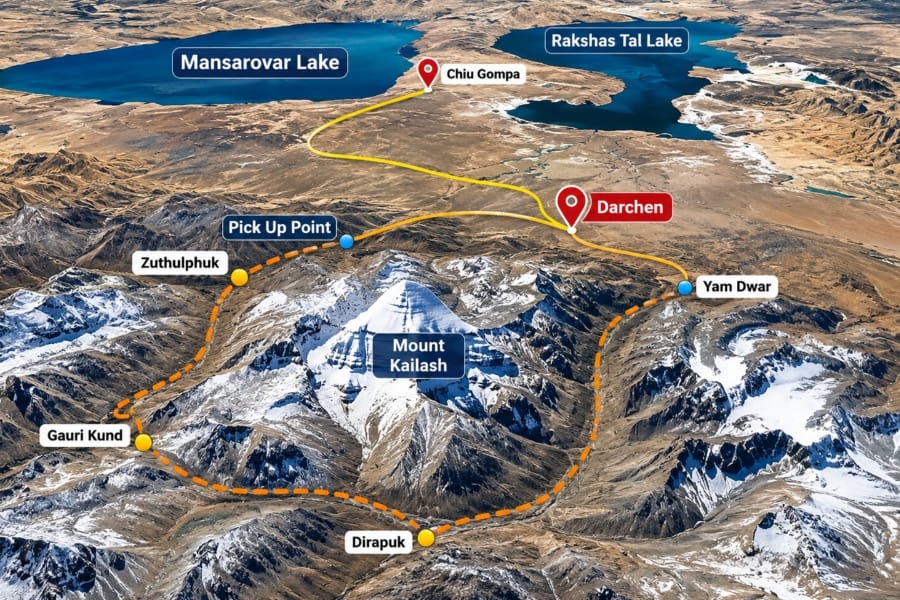
Its geographical location and proximity to Mount Kailash make it an important natural landmark and a major pilgrimage destination for Hindu and Buddhist devotees.
Lake Mansarovar Location in Tibet, China
Lake Mansarovar is situated near the southern foothills of Mount Kailash, approximately 30 km from the sacred mountain. It is located at an altitude of approximately 4,590 metres above sea level and is also known by its Tibetan name, Mapham Yutso.
The lake's remote location, freshwater surroundings and proximity to Mount Kailash make it an important part of the Kailash Mansarovar pilgrimage region.
Lake Mansarovar Map and Geographical Coordinates
A Lake Mansarovar map helps identify the lake in western Tibet, China, near Mount Kailash and Rakshas Tal. Its approximate geographical coordinates are 30.65° N latitude and 81.47° E longitude, which help locate it on a map of the Tibetan Plateau.
The surrounding region includes high-altitude mountain landscapes and important pilgrimage sites. Travellers planning the Kailash Mansarovar Yatra should check the latest border regulations, authorised travel routes and permit requirements before beginning their journey.
Religious Significance of Lake Mansarovar
Lake Mansarovar is an important pilgrimage site for followers of Hinduism, Buddhism, Jainism and the Bon tradition. Each religion has its own beliefs, sacred associations and religious practices connected with the lake and the nearby Mount Kailash region. Its importance across these traditions makes it a unique centre of faith and pilgrimage.
Religious Significance of Lake Mansarovar in Hinduism
In Hinduism, Lake Mansarovar is considered one of the holiest lakes and holds immense religious significance. According to Hindu beliefs, Lord Brahma created the lake through his mind, while it is closely associated with Lord Shiva and Goddess Parvati. Devotees believe that bathing in its sacred waters cleanses sins and purifies the soul. A pilgrimage to Lake Mansarovar is considered spiritually significant as it represents devotion, inner purification and the pursuit of Moksha (liberation).
Connection Between Lake Mansarovar and Lord Shiva
According to Hindu beliefs, Mount Kailash is the abode of Lord Shiva and Goddess Parvati. Since Lake Mansarovar lies close to this sacred mountain, the surrounding region holds special importance for Shiva devotees. During the Kailash Mansarovar Yatra, pilgrims visit the lake to offer prayers, meditate and seek blessings from Lord Shiva.
Why Is Lake Mansarovar Considered Sacred?
Lake Mansarovar is considered sacred because Hindu traditions associate its waters with purity, faith and spiritual cleansing. Many devotees take a holy dip in Lake Mansarovar, believing that bathing in its waters helps cleanse past sins and brings spiritual merit. Offering prayers and meditating along its banks are also important religious practices.
If you are fortunate enough to visit Lake Mansarovar, you may experience moments that devotees describe as unimaginable miracles. For many pilgrims, these personal experiences make the journey even more meaningful. All religious activities should be performed while following local regulations and safety guidelines.
Religious Significance of Lake Mansarovar in Buddhism
In Tibetan Buddhism, Lake Mansarovar is associated with Anavatapta, a sacred lake mentioned in Buddhist traditions. The nearby Mount Kailash region is also important to Buddhist followers, who undertake religious journeys and circumambulation of the mountain as an expression of faith and devotion.
Religious Significance of Lake Mansarovar in Jainism
In Jain tradition, the Mount Kailash region is associated with Rishabhdev, the first Tirthankara. Jain beliefs connect the sacred site of Ashtapad with his attainment of liberation. This traditional association makes the wider Kailash region important to Jain devotees.
Religious Significance of Lake Mansarovar in Bon Tradition
The Bon tradition regards Mount Kailash, known as Tise, as a sacred spiritual centre. Bon beliefs associate it with Yungdrung Gutsek, or the Mountain of Nine Swastikas, symbolising the Nine Ways of Bon. Followers also believe that Tonpa Shenrab Miwoche, the founder of Bon, visited the region. Unlike Hindu and Buddhist pilgrims, Bon devotees traditionally circumambulate Mount Kailash in an anti-clockwise direction.
History and Traditional Stories of Lake Mansarovar
The history of Lake Mansarovar is closely connected with ancient Hindu beliefs, religious traditions and pilgrimage practices. Its name and account of its origin have been passed down through generations, making it an important part of Hindu religious literature and cultural heritage.
The Legend of Lord Brahma and the Creation of Lake Mansarovar
According to ancient Hindu traditions, Lord Brahma first conceived Lake Mansarovar in his mind before it manifested on Earth. The Sanskrit name Manasarovar comes from two words: Manas, meaning mind, and Sarovar, meaning lake. This traditional account explains the lake's association with divine creation, purity and spiritual significance.
Lake Mansarovar in Hindu Scriptures and Ancient Traditions
Lake Mansarovar has been celebrated in Hindu religious traditions for centuries. It is associated with sacred stories of sages, meditation and devotion to Lord Shiva. The pilgrimage to the Kailash–Mansarovar region has long been regarded as an important expression of faith for devotees seeking spiritual merit and a connection with the divine.
Geographical Features and Natural Beauty of Lake Mansarovar
Apart from its religious importance, Lake Mansarovar is known for its distinctive geographical setting and remarkable natural beauty. Its clear freshwater, open surroundings and views of snow-covered mountains create a striking landscape on the Tibetan Plateau.
Altitude, Size and Depth of Lake Mansarovar
Lake Mansarovar lies at approximately 4,590 metres above sea level. It covers an area of around 120 square miles, has a shoreline perimeter of approximately 88 km and reaches a reported depth of about 330 feet. Its freshwater characteristics and high-altitude location make it a remarkable geographical feature. Visitors should also be aware that the high elevation can cause altitude-related health problems.
Climate and Surrounding Natural Landscape
The region around Lake Mansarovar experiences a cold, high-altitude climate. Summers are comparatively milder, while winters bring severe cold, snowfall and challenging travel conditions. The lake is surrounded by open terrain and mountain views, with Mount Kailash forming an important part of its landscape. Weather conditions can change quickly, so visitors should prepare for low temperatures even during the main pilgrimage season.
Best Views and Scenic Attractions Around Lake Mansarovar
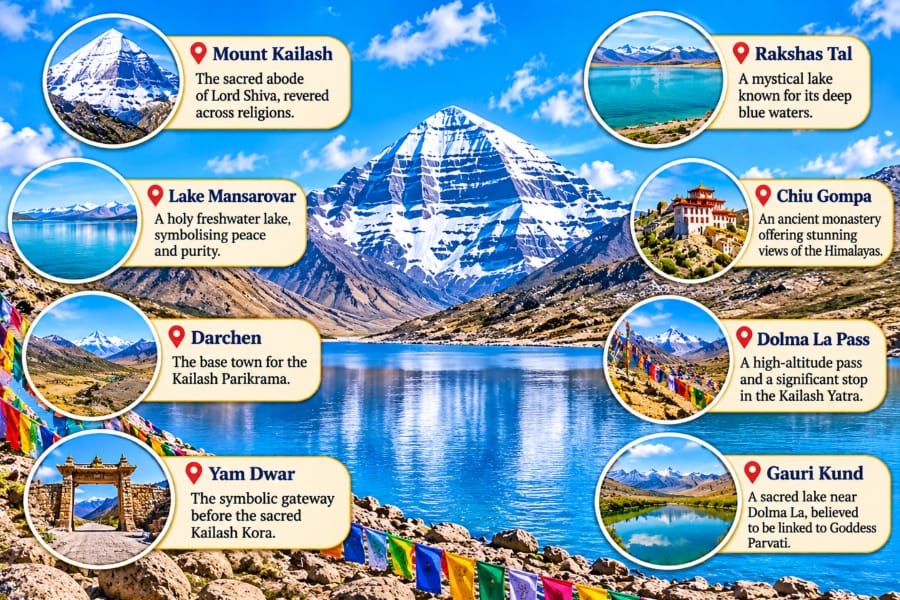
The region around Lake Mansarovar is known for its breathtaking Himalayan scenery, with snow-covered mountains, turquoise lakes and vast open landscapes. Mount Kailash stands as the most prominent landmark, while nearby Rakshas Tal offers a striking contrast with its deep blue saline waters. Visitors can also explore scenic and spiritual sites such as Chiu Gompa, Darchen, Yam Dwar, Dolma La Pass and Gauri Kund, each offering a distinct view of the sacred Kailash region.
Lake Mansarovar vs Rakshas Tal – What Is the Difference?
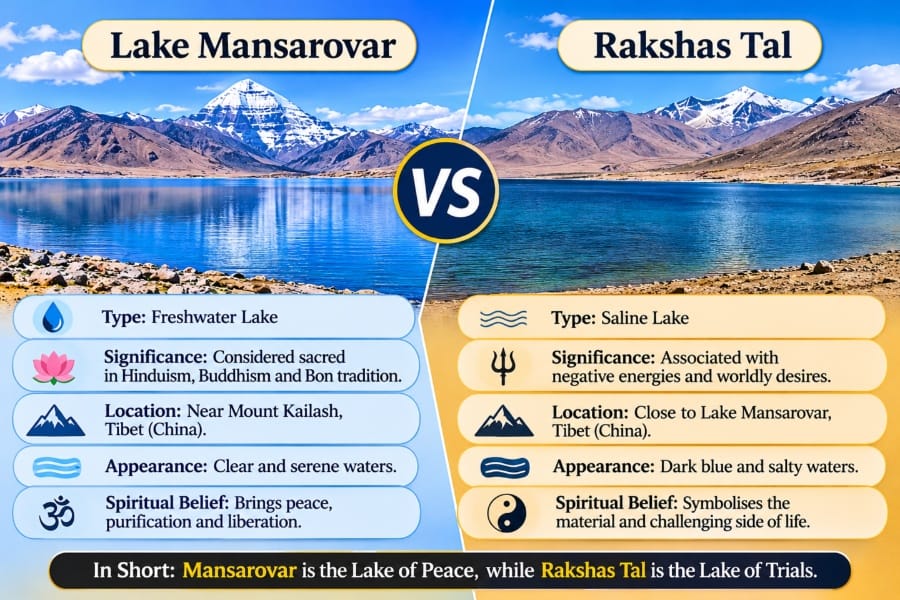
Lake Mansarovar and Rakshas Tal are two neighbouring lakes near Mount Kailash in Tibet. Although they are geographically close, they differ in their water characteristics and religious associations. Both are important landmarks of the Kailash Mansarovar region.
Religious and Traditional Differences
In Hindu traditions, Lake Mansarovar is associated with purity, divine creation and spiritual cleansing. Rakshas Tal, also known as Rakshastal, is traditionally connected with Ravana, who is believed to have worshipped Lord Shiva near the lake. These contrasting religious associations give the two lakes distinct identities in Hindu traditions.
Geographical and Water Characteristics
Lake Mansarovar is a freshwater lake, whereas Rakshas Tal is a saline lake. Their contrasting water characteristics and surrounding landscapes make them distinctive natural features of the region. While Lake Mansarovar is generally associated with spiritual purity, Rakshas Tal is connected with different traditional religious beliefs.
Lake Mansarovar Parikrama – Meaning and Spiritual Importance
Parikrama is a traditional religious practice in which devotees walk or travel around a sacred place as an expression of devotion. In the Kailash–Mansarovar region, pilgrims may undertake circumambulation around Lake Mansarovar as part of their spiritual journey. This is different from the Mount Kailash Parikrama, which follows a separate route around the mountain.
What Is Lake Mansarovar Parikrama?
Lake Mansarovar Parikrama refers to travelling around the lake's perimeter. Pilgrims undertake this journey to express their devotion, offer prayers and experience the spiritual atmosphere of the region. Unlike Mount Kailash Parikrama, the lake circuit is generally covered using available local transport, depending on access and conditions.
How Long Does Lake Mansarovar Parikrama Take?
The shoreline perimeter of Lake Mansarovar is approximately 88 km. The time required to travel around it depends on the route, transport arrangements, road conditions and weather. Visitors should confirm the available arrangements with their authorised tour operator or local authorities rather than assume that the entire circuit is accessible.
Kailash Mansarovar Yatra – A Sacred Pilgrimage
The Kailash Mansarovar Yatra is one of the most significant pilgrimages for devotees of Lord Shiva. It combines a visit to Mount Kailash with time at Lake Mansarovar, allowing pilgrims to experience two of the region's most revered spiritual landmarks. The journey is known for its religious importance as well as its demanding high-altitude conditions.
Religious Importance of Kailash Mansarovar Yatra
Hindus believe that Mount Kailash is the divine residence of Lord Shiva and Goddess Parvati, while Lake Mansarovar is associated with purity and spiritual cleansing. Visiting both places is therefore considered deeply meaningful. Pilgrims undertake the journey to offer prayers, perform religious rituals and seek blessings.
Major Routes for Kailash Mansarovar Yatra
The Ministry of External Affairs, Government of India, organises the official Kailash Mansarovar Yatra through two routes:
- Lipulekh Pass route: This route passes through Uttarakhand and enters Tibet through Lipulekh Pass.
- Nathu La Pass route: This route passes through Sikkim and enters Tibet through Nathu La Pass.
The pilgrimage is organised in coordination with the concerned state governments, the Indo-Tibetan Border Police and other government agencies. Private travel arrangements through Nepal may also be available, subject to separate permissions and current border regulations.
Spiritual Rituals Performed During the Yatra
Pilgrims may offer prayers, meditate and perform traditional rituals at Lake Mansarovar. Some devotees take a holy dip in its water as an expression of faith, while others collect a small quantity of water where local rules permit. The journey also gives pilgrims an opportunity to reflect, practise devotion and experience the peaceful surroundings of the sacred region.
How to Reach Lake Mansarovar?
Reaching Lake Mansarovar requires careful planning because it is situated in a remote, high-altitude region of Tibet. Indian pilgrims can apply for the government-organised Yatra through the official routes, while other travellers may explore permitted arrangements through Nepal-based operators. Access depends on current border regulations, permits and travel conditions.
Reaching Lake Mansarovar Through India
Indian citizens can apply for the Kailash Mansarovar Yatra organised by the Ministry of External Affairs. The two official routes are through Lipulekh Pass in Uttarakhand and Nathu La Pass in Sikkim. The journey involves designated transit points, medical checks and high-altitude travel. Applicants should follow the instructions published on the official pilgrimage portal.
Reaching Lake Mansarovar Through Nepal
Some private pilgrimage itineraries use Nepal as a transit point before entering Tibet. Depending on authorised arrangements, the journey may involve travel by road or helicopter-assisted services. These options are subject to Tibet entry permissions, border conditions and operator arrangements. Travellers should confirm that their chosen itinerary is authorised.
Permits and Documents Required
Travel requirements depend on the route and type of pilgrimage. For the Government of India's organised Yatra, applicants need a valid Indian passport and must meet the eligibility and medical fitness conditions announced for that year's pilgrimage. Travel to Tibet also requires the applicable Chinese visa and travel permissions, which are generally coordinated through authorised arrangements. Always check the latest instructions on the official Kailash Mansarovar Yatra portal before applying.
Planning your Kailash Mansarovar Yatra? Trip To Temples (TTT) can help with permits, documentation and travel arrangements for a hassle-free pilgrimage.
Best Time to Visit Lake Mansarovar
The best time to visit Lake Mansarovar is generally between June and August, when the annual Kailash Mansarovar Yatra is organised by the Ministry of External Affairs (MEA), Government of India. Indian pilgrims must apply for the Yatra and secure a place through the limited annual quota. The pilgrimage schedule depends on weather conditions, route availability and government permissions.
Annual Quota and Selection Process
The Ministry of External Affairs invites applications for the Kailash Mansarovar Yatra each year. Since the number of pilgrims is limited, applicants are selected through a computer-generated random selection process. To qualify, applicants must meet the announced eligibility criteria, submit the required documents and clear the prescribed medical examinations.
When Should You Apply for the Kailash Mansarovar Yatra?
Pilgrims planning to visit Lake Mansarovar should check the official MEA announcement and Kailash Mansarovar Yatra portal when registrations open each year. Keep your passport and other necessary documents ready in advance. The final travel dates, route details and batch allocation are communicated according to the official pilgrimage schedule.
Important Things to Know Before Visiting Lake Mansarovar
A visit to Lake Mansarovar requires more preparation than an ordinary sightseeing trip. Its high altitude, remote location and unpredictable weather can make the journey physically demanding. Pilgrims should understand the travel requirements and prepare carefully before departure.
Altitude Sickness and Medical Preparation
Lake Mansarovar is situated at approximately 4,590 metres, where low oxygen levels can cause altitude sickness. Symptoms may include headaches, nausea, dizziness, fatigue and breathlessness. Based on our experience of organising pilgrimage journeys over the years, we recommend completing the required medical check-ups, allowing sufficient time for acclimatisation and avoiding strenuous activities during the initial days. Keep your medical team informed about any discomfort and seek immediate assistance if symptoms become severe. Proper preparation and following medical advice can make your Kailash Mansarovar Yatra safer and more comfortable.
Clothing and Essential Travel Items
Visitors should carry warm layers, thermal wear, insulated jackets, gloves, woollen socks and comfortable footwear. Sunglasses, sunscreen, personal medicines, a basic first-aid kit and reusable water bottles are also useful. Weather conditions can change quickly, so suitable clothing is important even during summer.
Accommodation, Food and Travel Facilities
Facilities in the Lake Mansarovar region are basic compared with those in major tourist destinations. Accommodation, food and transport arrangements depend on the chosen route and authorised itinerary. Mobile connectivity and access to medical facilities may also be limited in remote areas. Travellers should confirm these details before beginning the journey.
Environmental Importance and Conservation of Lake Mansarovar
Lake Mansarovar is not only a sacred pilgrimage destination but also an important part of the high-altitude environment of the Tibetan Plateau. Its freshwater ecosystem and surrounding natural landscape make environmental protection essential, particularly as pilgrimage and tourism bring visitors to the region.
Why Is Lake Mansarovar Environmentally Important?
As a high-altitude freshwater lake, Lake Mansarovar supports a distinctive natural ecosystem. Its surrounding landscape and wetlands form part of the wider Tibetan Plateau environment. Protecting the lake helps preserve its water quality, natural surroundings and ecological balance.
Conservation Challenges Around Lake Mansarovar
Tourism, pilgrimage activity and waste disposal can put pressure on fragile high-altitude environments. Visitors should avoid littering, follow designated routes, respect local regulations and minimise their environmental impact. Keeping the lake and its surroundings clean is important for protecting this sacred natural landmark for future generations.
Interesting Facts About Lake Mansarovar
- One of the world's highest freshwater lakes: Lake Mansarovar sits at approximately 4,590 metres above sea level.
- Located near Mount Kailash: The lake lies close to the mountain regarded as the abode of Lord Shiva in Hinduism.
- A name rooted in ancient Sanskrit: The name Manasarovar comes from the Sanskrit words Manas (mind) and Sarovar (lake).
- Close to Rakshas Tal: The two neighbouring lakes have different water characteristics and mythological associations.
- Important to multiple traditions: The wider Kailash–Mansarovar region is revered in Hinduism, Buddhism, Jainism and Bon.
- A major pilgrimage destination: The Kailash Mansarovar Yatra is an important spiritual journey for devotees, subject to eligibility and travel permissions.
Conclusion
Lake Mansarovar is a sacred freshwater lake in Tibet, known for its religious significance, natural beauty and proximity to Mount Kailash. It is an important pilgrimage destination for followers of Hinduism, Buddhism, Jainism and the Bon tradition. Whether you are visiting for spiritual reasons or to experience its peaceful Himalayan surroundings, planning the Kailash Mansarovar Yatra requires attention to permits, travel routes, medical fitness and official guidelines. With proper preparation and authorised travel arrangements, pilgrims can make their journey to Lake Mansarovar a meaningful spiritual experience.
Talk to Our Expert
Submit your contact number. Our Expert will call you within 1 minute.
Reach out to us
Have An Enquiry? Write To Us…

Popular Packages
Frequently Asked Questions
Lake Mansarovar – The Invincible Holy Lake in Hinduism
We Got Featured in the Media















What Yatris Talk About Us

Trip To Temples
India’s No. 1 pilgrimage travel planner with a decade of expertise. We are the one who started the Kailash Aerial Darshan package. Guided by "Har Safar, Bharose Par," we craft safe, comfortable, and spiritually enriching journeys to Kailash Mansarovar, Char Dham, Adi Kailash, Nepal and beyond.
Tour Resources
Trip To Temples Packages
Popular Destinations
Download The App


© 2026 Trip To Temples. All Rights Reserved.
Design & Developed By : Divine Mantra Pvt Ltd